OpenAI Launches ChatGPT Personal Finance With Bank Linking via Plaid, Targeting Fintech Incumbents
OpenAI launched a personal finance preview for ChatGPT Pro users in the US, enabling connections to more than 12,000 financial institutions via Plaid and powered by GPT-5.5, putting the company in direct competition with Intuit and dedicated fintech apps.
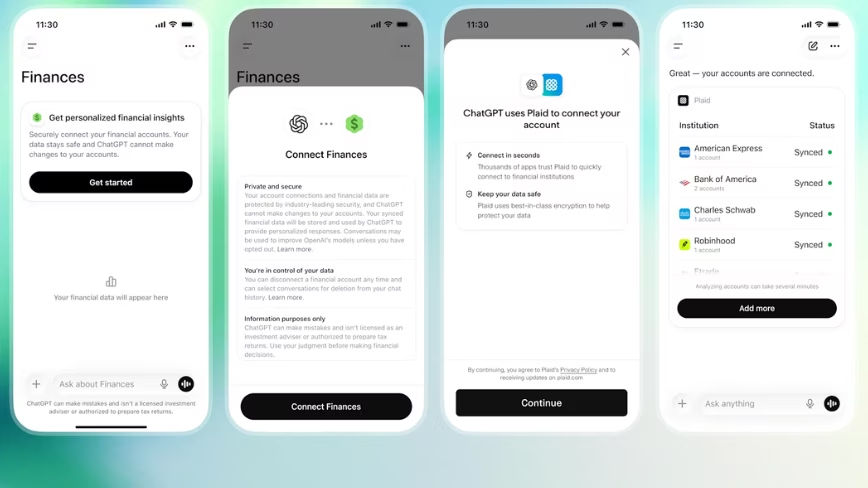
OpenAI launched a personal finance feature in preview on May 15, 2026, allowing ChatGPT Pro subscribers in the United States to connect bank accounts, investment portfolios, and credit cards through Plaid's financial-data infrastructure — a move that positions the company as a direct competitor to Intuit, Mint successors, and a generation of standalone budgeting applications.
How the Feature Works
Users access the tool by selecting "Finances" in the ChatGPT sidebar or by typing "@Finances, connect my accounts" in a conversation. The integration links to over 12,000 financial institutions via Plaid, including Schwab, Fidelity, Chase, Robinhood, American Express, and Capital One. Once connected, ChatGPT displays a dashboard covering portfolio performance, spending patterns, active subscriptions, and upcoming payment obligations.
The underlying model is GPT-5.5, which OpenAI developed with enhanced reasoning capabilities specifically targeted at financial analysis tasks. The practical effect is that users can ask questions in plain language — "Why did my spending increase in March?" or "What would I need to save monthly to buy a house in three years?" — and receive answers that draw on their actual account data rather than hypothetical scenarios.
OpenAI acquired the team behind personal finance startup Hiro in April 2026, roughly a month before the launch. Hiro had backing from Ribbit Capital, General Catalyst, and Restive, and its engineers brought direct experience in financial data normalisation and user-facing money-management interfaces.
A planned integration with Intuit would extend the feature's scope to tax analysis — modelling the consequences of a stock sale on a user's estimated tax liability, for instance — and credit assessment. OpenAI said that integration is in preparation but not yet live.
The Privacy and Data Question
The feature carries privacy considerations that the company acknowledged in its launch materials. ChatGPT cannot view full account numbers or initiate transactions, and connected accounts can be disconnected at any time, with a 30-day data retention window after disconnection.
More contested is the question of training data. By default, users who have enabled the "improve the model for everyone" setting — which is switched on automatically unless turned off — allow their financial information to contribute to model training. Gang Wang, an associate professor of computer science at the University of Illinois, noted the structural risk: financial documents in AI training data could potentially be induced by adversarial prompts, creating a vector for information leakage that is distinct from conventional account fraud.
OpenAI's previous data breach history, including incidents that surfaced conversation metadata from ChatGPT sessions, means that security researchers are likely to apply close scrutiny to the personal finance feature as it expands beyond the preview cohort.
Why This Matters for the Fintech Landscape
OpenAI framing this as a consumer product rather than an API capability is a significant escalation in its ambitions. More than 200 million people already ask ChatGPT financial questions each month, according to the company's own figures — advice about budgeting strategy, investment principles, and loan comparisons. The personal finance feature converts that passive Q&A behaviour into something that can access real account data and generate personalised, verifiable recommendations rather than generic guidance.
Intuit's TurboTax Copilot and Credit Karma's AI features are the most direct incumbents, but the competitive pressure extends to any service that has relied on natural-language financial advice as a moat. Conversational interfaces were once a differentiator for fintech; integrating them into the world's most widely used AI assistant at no additional cost to Pro subscribers changes the competitive calculus substantially.
The launch also advances OpenAI's strategy of expanding ChatGPT from a text-generation tool into a platform that manages consequential personal data — a trajectory that includes the memory features, the forthcoming agent capabilities in the unified platform that Greg Brockman is now overseeing, and the international expansion under the "OpenAI for Countries" programme. Each of these moves brings new regulatory scrutiny, particularly in the EU where financial data handling falls under multiple overlapping frameworks.
The personal finance preview is currently US-only, with no announced timeline for international availability. Given EU data protection requirements under GDPR and the upcoming AI Act transparency obligations, any European rollout would require a substantially different data-handling architecture.
Sources
- ↳https://openai.com/index/personal-finance-chatgpt
- ↳https://techcrunch.com/2026/05/15/openai-launches-chatgpt-for-personal-finance-will-let-you-connect-bank-accounts/
- ↳https://gizmodo.com/chatgpt-can-now-connect-to-your-bank-account-and-see-all-your-transactions-2000759306
- ↳https://thenextweb.com/news/openai-chatgpt-personal-finance-plaid