gpt-oss: How OpenAI's Apache 2.0 Release Reshaped Open-Weight AI
OpenAI gpt-oss-120b and gpt-oss-20b under Apache 2.0 hit 12 million downloads and set the open-weight benchmark other 2026 model releases compete against.
When OpenAI released gpt-oss-120b and gpt-oss-20b under the Apache 2.0 licence — its first ever permissive open-weight models — the AI research community treated it primarily as a competitive signal: an acknowledgement that open-weight releases from Meta, Mistral, and the wave of Chinese labs had forced OpenAI's hand. Months on, the download numbers and the benchmark trajectories tell a more substantive story about what the models actually changed in the open-weight landscape.
The 120B model has accumulated 4.63 million downloads on Hugging Face; the 20B model has reached 7.37 million. Together they have become the de facto baseline against which open-weight releases in mid-2026 are compared, and deployment guides on Northflank, Databricks, Azure AI Foundry, and Hugging Face have collectively made them among the most widely hosted open-weight models in the current ecosystem.
Architecture and Hardware Access
Both models use a Mixture-of-Experts architecture with token-choice routing and SwiGLU activations, quantised to 4-bit MXFP4 format for the MoE weights. The architectural choices prioritise inference efficiency: the 120B model has 117 billion total parameters but only 5.1 billion active parameters per forward pass, allowing it to fit on a single 80GB GPU — a single H100 or equivalent — despite its headline parameter count. The 20B model has 21 billion total parameters and 3.6 billion active, running on as little as 16GB of GPU memory, which places it within reach of consumer hardware including RTX 4090 and RTX 5080 cards as well as Kaggle and Google Colab free tiers.
That hardware accessibility is significant because the previous class of open-weight models with comparable reasoning capability required multi-GPU setups that were practical for research labs and cloud deployments but impractical for individual developers running experiments locally. The gpt-oss-20B runs on a single consumer card with reasoning capability — including adjustable effort levels ranging from low-cost fast responses to slower high-accuracy chains of thought — that previously required access to an API.
Benchmark Performance
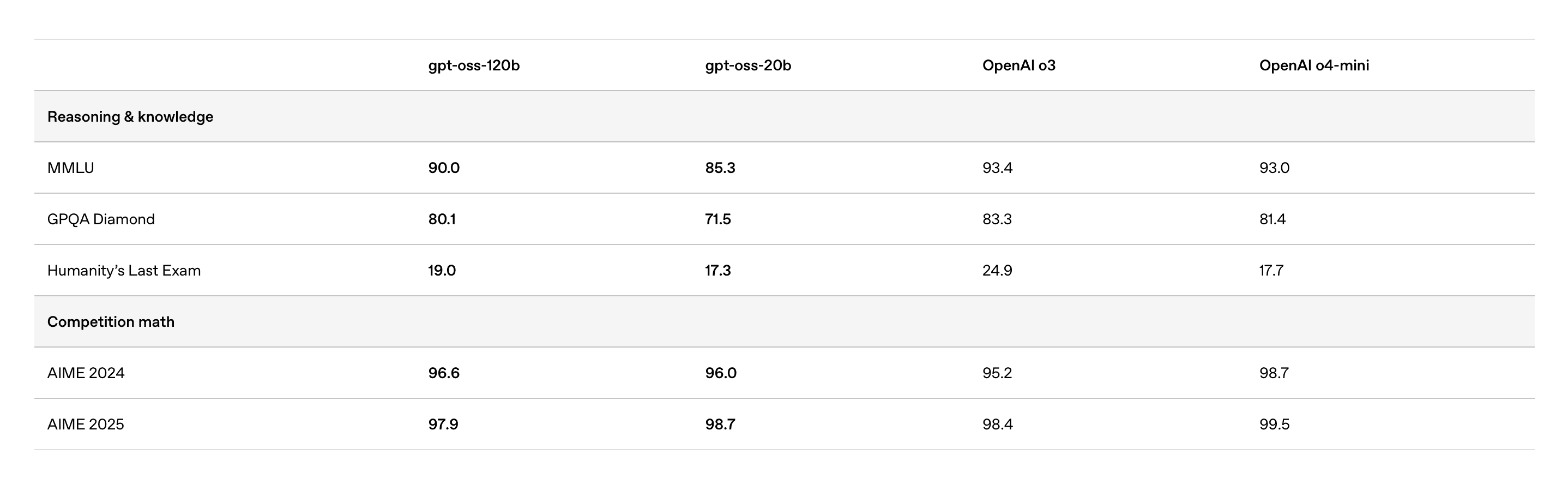
Hugging Face's evaluation data shows the 20B model scoring 69.5 on IFEval (instruction following) and 63.3 on AIME 2025 (mathematical reasoning), competitive with models significantly larger in raw parameter count. The 120B model approaches near-parity with OpenAI's own o4-mini on reasoning benchmarks, which is the most striking finding: an open-weight, locally deployable model performing at a level that was the exclusive domain of frontier proprietary systems a year ago.
The benchmark performance has made gpt-oss-120b the reference point for comparisons in the current crop of Chinese and Western open-weight releases. When Z.ai published GLM-5.1 and Moonshot released Kimi K2.6 this spring, both labs benchmarked against gpt-oss as the primary open-weight baseline, signalling that OpenAI's models have set the competitive floor the ecosystem is now trying to exceed rather than simply match.
Enterprise and Cloud Deployment
The models are available through Azure AI Foundry and Windows AI Foundry, making them accessible to Microsoft enterprise customers alongside Azure-hosted proprietary models. That positioning is unusual: OpenAI's API models compete for the same enterprise budget that the open-weight models are now available to address — a tension that reflects the complexity of OpenAI's commercial relationship with Microsoft.
Northflank published a detailed self-hosting guide for gpt-oss-120b that documented the full stack from container configuration to inference benchmarking on cloud GPU instances. The guide found that a self-hosted 120B deployment on a single H100 instance produced costs approximately 60 percent lower than equivalent OpenAI API pricing for comparable throughput, which is the economic proposition that enterprise architecture teams are currently evaluating.
The Competitive Effect
The gpt-oss release shifted the conversation about OpenAI's open-weight strategy from "will they ever release anything?" to "what does their release mean for everyone else?" Llama 4, Mistral's Devstral, Qwen 3, and the wave of Chinese MoE models released in the first half of 2026 were all developed with the knowledge that gpt-oss would be available as a comparison benchmark. Some, like Qwen 3, chose to exceed it on specific metrics; others, like Devstral, focused on specialised coding performance where the gpt-oss models are not optimised.
The Apache 2.0 licence has been the most commercially enabling aspect of the release. Unlike Meta's Llama licence, which places restrictions on applications above a certain revenue threshold, Apache 2.0 allows unrestricted commercial use without revenue caps or usage fees — removing the legal friction that had caused some enterprise legal teams to advise against building production systems on Llama-derived models.
Whether OpenAI will release a successor to the gpt-oss models — or whether the release was a one-time strategic concession rather than a new default — remains unclear. The download numbers suggest the models have found a durable audience that will continue to shape benchmarking expectations for whatever comes next.
Sources
- ↳https://huggingface.co/blog/welcome-openai-gpt-oss
- ↳https://northflank.com/blog/self-host-openai-gpt-oss-120b-open-source-chatgpt
- ↳https://azure.microsoft.com/en-us/blog/openais-open%E2%80%91source-model-gpt%E2%80%91oss-on-azure-ai-foundry-and-windows-ai-foundry/
- ↳https://builtin.com/articles/openai-gpt-oss-release